


I still remember my first steps into the crypto world back in 2017. The air was thick with bold predictions. We’d sit around speculating about the day institutional investors would pour in, or when entire nations might adopt Bitcoin as legal tender. At the time, it felt like pure fantasy, the kind of thing you’d dream about in a late-night bull market discussion.
Fast forward to today, and a lot of that “someday” talk has become reality. El Salvador actually made Bitcoin legal tender. In the US, new laws are being shaped to fit Bitcoin into the financial system. Things we once saw as distant possibilities are now playing out in front of us.
But that brings me to the real question: as Bitcoin matures, will the price keep running to the moon forever… or are we moving into a stage where it behaves more like a traditional asset?
Global Shifts in Bitcoin Adoption
The evolution over the past few years has been incredible. El Salvador led the way, but they weren’t alone. The US has been talking about creating a Strategic Bitcoin Reserve, Bhutan has quietly mined Bitcoin for years, and even Iran has woven Bitcoin into parts of its economic strategy.
Meanwhile, the rules of the game are getting clearer. In Europe, the MiCA regulation lays out a proper framework for crypto assets. In the US, the approval of spot Bitcoin ETFs in early 2024 opened the door for everyday investors to buy Bitcoin through the same channels they use for stocks.
Sure, Bitcoin still isn’t something you use to buy your morning coffee, and the user experience has a way to go, but the sheer level of institutional and government involvement tells me one thing: mainstream adoption might not look like mass payments at the checkout counter. It might instead mean Bitcoin becomes a widely held, highly regulated global asset.
Bitcoin as a Global Standard
Whenever I think about Bitcoin’s long-term role, I can’t help but compare it to gold. It’s the obvious parallel, gold has been the go-to store of value for centuries, and Bitcoin is now making a bid to be its digital counterpart.
But here’s the twist: while gold is undeniably decentralised and free from direct control by any single government, Bitcoin has something gold can’t match, it’s native to the internet. It can move across the globe in minutes, settle transactions without a central authority, and operate 24/7 without relying on a physical supply chain.
In times of geopolitical tension or monetary uncertainty, that matters. It means Bitcoin isn’t just a “digital gold”, it’s a potential neutral settlement layer for the modern age. Not a replacement for gold’s physical utility, but an entirely new kind of reserve asset built for borderless commerce.
The Rise of Institutional and Governmental Adoption
We’ve moved past the “if” stage when it comes to governments and institutions getting involved. It’s already happening. El Salvador holds Bitcoin on its balance sheet. Publicly traded companies have it in their treasuries. Hedge funds treat it as part of their macro strategy.
And every time another government passes a Bitcoin-friendly regulation, or another big player adds it to their portfolio, the base of the network strengthens. This growing alignment between technical potential, regulatory clarity, and institutional confidence could be the spark that pushes Bitcoin into territory we once thought was unreachable.
Charting the Path to Gold’s Market Cap
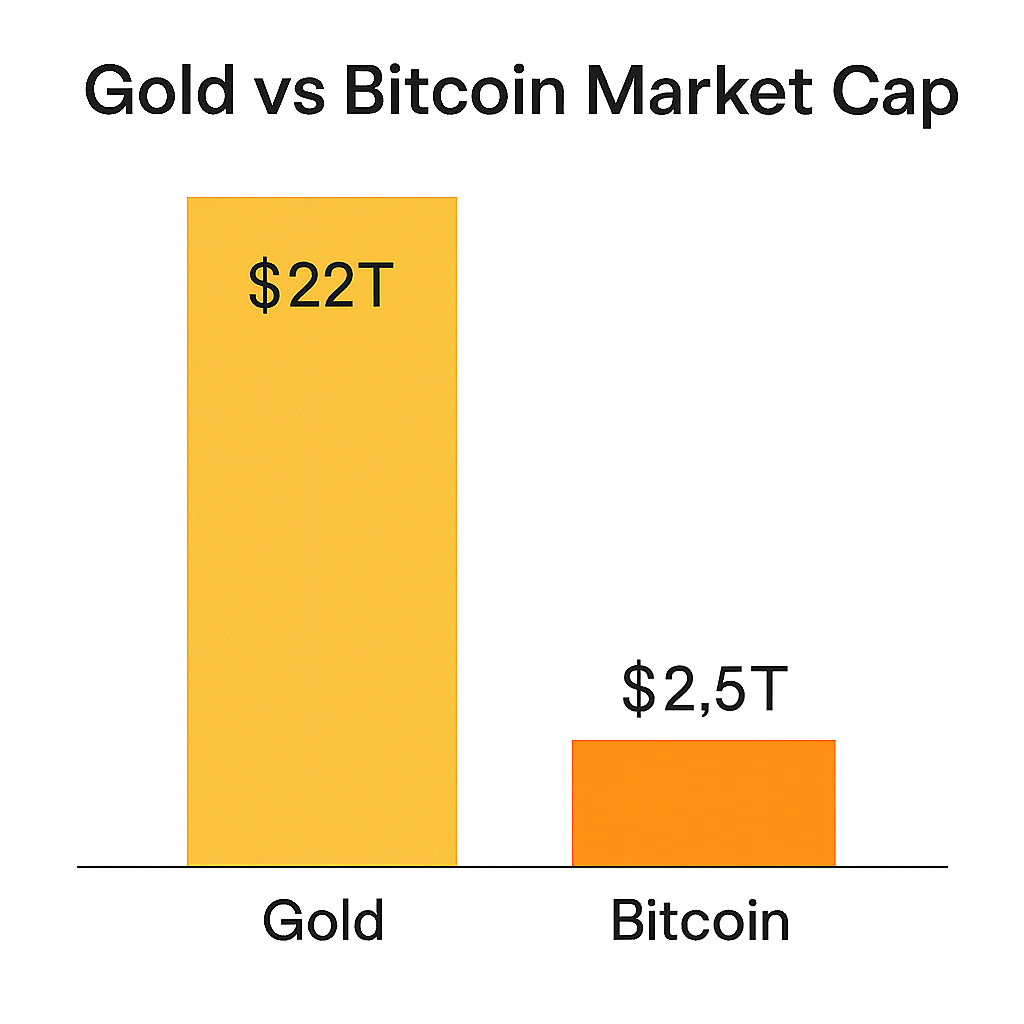
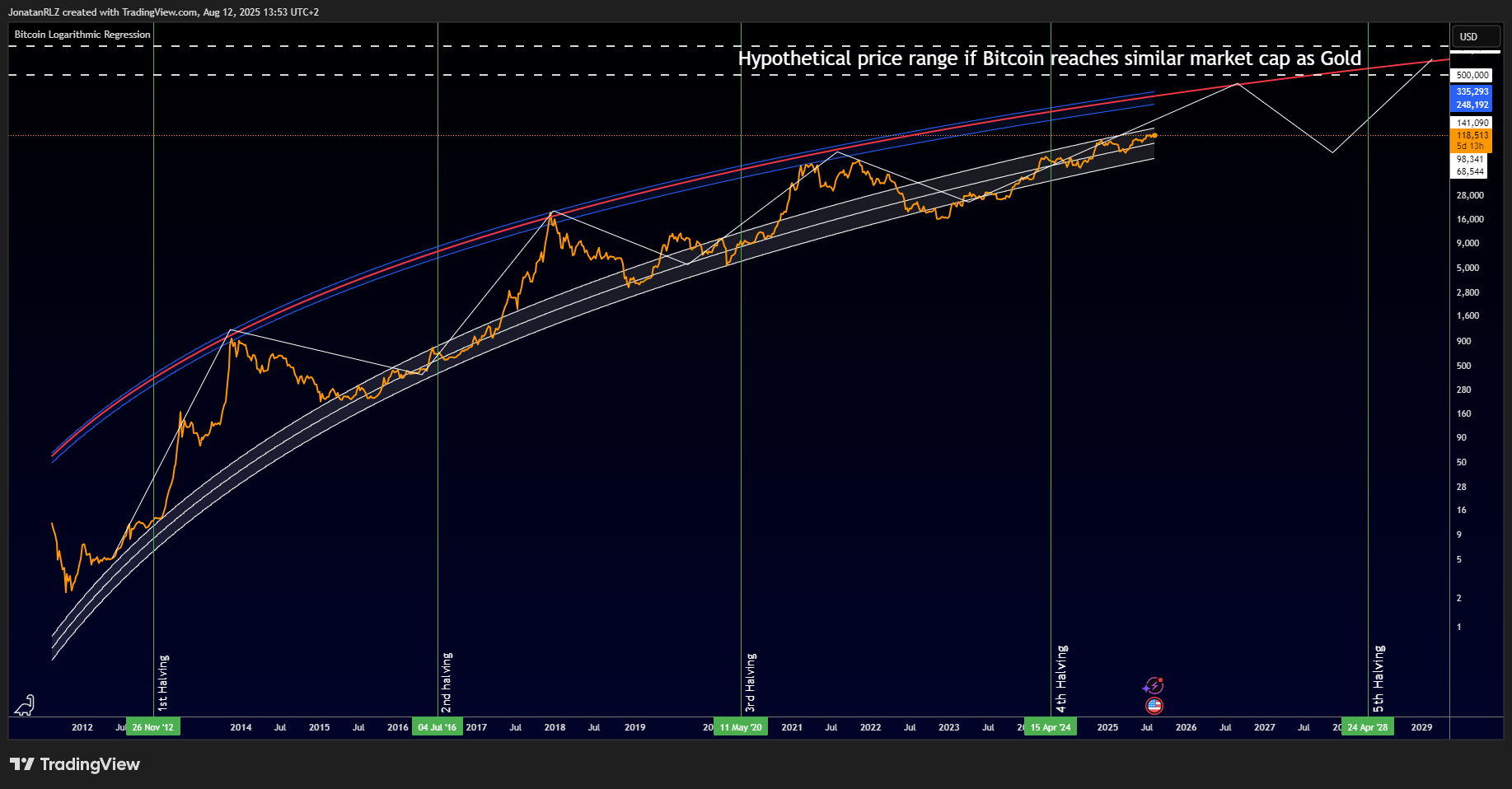
Now, here’s where it gets interesting. Imagine Bitcoin’s market cap climbing to match gold’s, currently sitting around $22 trillion. In that scenario, the price of a single Bitcoin would be well into the six figures.
The chart I’m looking at overlays Bitcoin’s historical price with a logarithmic regression model, marking each halving along the way. Since 2012, each halving has kicked off a new growth phase, though the curve has been tightening as the market matures.
The upper band of this model? It lines up with a price north of $300,000 in a full-scale adoption phase. That’s not a wild guess, it’s what the math suggests if current growth trends continue.
And here’s the point: the same forces that once made Bitcoin a niche asset for early adopters are now converging with mainstream finance. That’s a recipe for a very different kind of growth, one that could eventually see Bitcoin standing shoulder to shoulder with gold as a global standard for value preservation.
If you’ve been around long enough to remember when $10,000 Bitcoin felt crazy, you know how quickly the impossible can turn into the obvious. The only question left is whether we’re witnessing the slow end of gold’s dominance… or the beginning of a shared reign.